
What Is Small Business Brick & Mortar Marketing?
A Strategy That Turns Data Capture Into Physical Store Visits
Brick & mortar marketing is any hyperlocal marketing strategy built to get real, nearby people into a physical small business's front door — all the while using a mobile app like CliquePrize® that can provide verified-location targeting to capture and earned marketing list, then subsequently using channels like email and SMS to convert that list into repeat, in-person visits. It's a different discipline from general digital marketing because every tactic has to pass one test: can the person seeing it realistically walk through the door? This article is courtesy of CliquePrize®.
By CliquePrize staff
July 24, 2026

Grow your Brick & Mortar Small Business With CliquePrize®!Brick & Mortar Small Businesses grow with data captured inexpensively thru giveaways.
As a Sponsor, how do you grow your Brick & Mortar Small Business without blowing your marketing budget? The answer surprised me: it's not more ads. It's data. Here's how I got it — I started running free prize giveaways through CliquePrize®.
Here's how it works: 🎯 Local shops (like mine) are Sponsors 🎯 Nearby consumers are Contestants 🎯 It uses Apple Location Services, so every Contestant is genuinely close to my store.
The exchange is simple. Contestants enter for free and get a shot at a great prize. In return, I get permission to reach them by email and SMS — opt-out anytime, all managed securely through an MS Azure app.
What Is Small Business Brick & Mortar Marketing?
Every marketing dollar a physical business spends has to answer one question that a purely online business never has to worry about: will this reach someone close enough to actually walk through my door? That single constraint is what separates brick & mortar marketing from marketing in general, and it's the reason strategies that work beautifully for e-commerce brands often fail — or waste money — for a local storefront.
Brick & mortar marketing is any strategy built to get real people, in a real neighborhood, into a physical business's front door, and back again. Unlike broad digital advertising aimed at anyone, anywhere, it's hyperlocal by design. It targets the ZIP codes, streets, and surrounding radius a storefront can realistically serve, then converts that attention into foot traffic, phone calls, bookings, and repeat visits — not just clicks, impressions, or likes.
For salons, gyms, restaurants, HVAC companies, medspas, and every other business that depends on someone physically showing up, this is the difference between a marketing dollar that reaches a stranger three states away and one that reaches a neighbor who could stop in this afternoon.
Brick & Mortar Marketing, By the Numbers
- Physical stores still account for roughly 83%–85% of all US retail sales, even after a decade of e-commerce growth — the "retail apocalypse" headline doesn't match the underlying data (U.S. Census Bureau retail trade estimates).
- 86% of shoppers research a product or business online before ever buying in-store — the ROPO effect (research online, purchase offline) makes local visibility a prerequisite for foot traffic, not an optional extra (Capital One Shopping consumer research).
- 67% of BOPIS customers (buy online, pick up in-store) buy at least one additional item during pickup — proof that getting someone physically in the building is still where a large share of incremental revenue gets made (industry click-and-collect studies).
These numbers matter for one reason: they confirm that "digital vs. physical" is the wrong framing. The businesses winning right now are the ones using digital channels to drive people into a real building — which is exactly what brick & mortar marketing is built to do.
Why "Local" Isn't Just a Targeting Setting
It's tempting to think brick & mortar marketing is simply regular digital marketing with a location filter turned on. In reality, the physical constraint changes the entire strategy, not just the targeting radius.
A national e-commerce brand can run an ad to someone a thousand miles away and still complete the entire customer journey — awareness, purchase, delivery — without that person ever leaving their couch. A brick & mortar business can't. No matter how good the ad is, if the person seeing it can't reasonably visit the location, the ad has failed at its actual job. This means every channel, every message, and every offer in brick & mortar marketing has to be built around proximity as the first filter, not an afterthought layered on at the end.
That's why verified location data matters so much more here than in general digital marketing. A giveaway or promotion that confirms an entrant is genuinely nearby — using something like Apple Location Services rather than a self-reported ZIP code — is worth dramatically more to a physical business than one that simply casts a wide net and hopes for the best. Every lead that isn't actually local is a lead you paid for and can never convert into a visit.
The Four Pillars of Brick & Mortar Marketing
Effective brick & mortar marketing generally rests on four connected pillars, each building on the last:
- Location-based targeting. Everything starts with reaching people who are physically close enough to visit — not just today's browsing history or general interest, but genuine geographic proximity to your storefront.
- Lead and list building. Attention that disappears the moment someone scrolls past is worthless. The goal of any brick & mortar campaign should be capturing a name, phone number, or email address you own outright, not one you're renting from a platform's algorithm.
- Foot traffic conversion. Online attention only matters if it turns into someone walking through your door. This is where in-store promotions, buy-online-pick-up-in-store (BOPIS) options, and location-specific offers come in — they give a captured lead a concrete reason to show up in person.
- Repeat-visit loyalty. The easiest customer to get is one you already have. Brick & mortar marketing that stops after the first visit is leaving the most profitable part of the relationship on the table. Keeping past customers coming back through follow-up offers and loyalty touchpoints is often more valuable than anything spent acquiring them in the first place.
Pre-Promotion and Post-Promotion: The Two Phases in Practice
Just like small business marketing broadly, brick & mortar marketing works best as a two-phase system, and the phases map directly onto the four pillars above.
In the pre-promotion phase, the job is pure reach: getting as many genuinely local people as possible to notice your business and opt into something — a giveaway, a raffle, a sweepstakes, a photo contest. This phase uses outward-facing channels: local SEO so you show up when someone nearby searches, paid and organic social media, in-store signage, community partnerships with other local businesses, and event-based promotions at your own location. None of these channels are trying to close a sale. They're trying to convert a passerby into a captured contact.
In the post-promotion phase, the strategy flips entirely. Now that you have a list of verified local leads, the highest-value channels are the ones you own directly: email and SMS text messaging. This is where the actual foot traffic gets driven — sending coupons, limited-time offers, and exclusive VIP event invitations that give a specific, time-bound reason to visit. A list that sits untouched after a promotion ends is a wasted asset; a list that's activated with a real follow-up sequence is often where the majority of a brick & mortar promotion's revenue actually comes from.
What Does It Cost to Acquire a Local Customer?
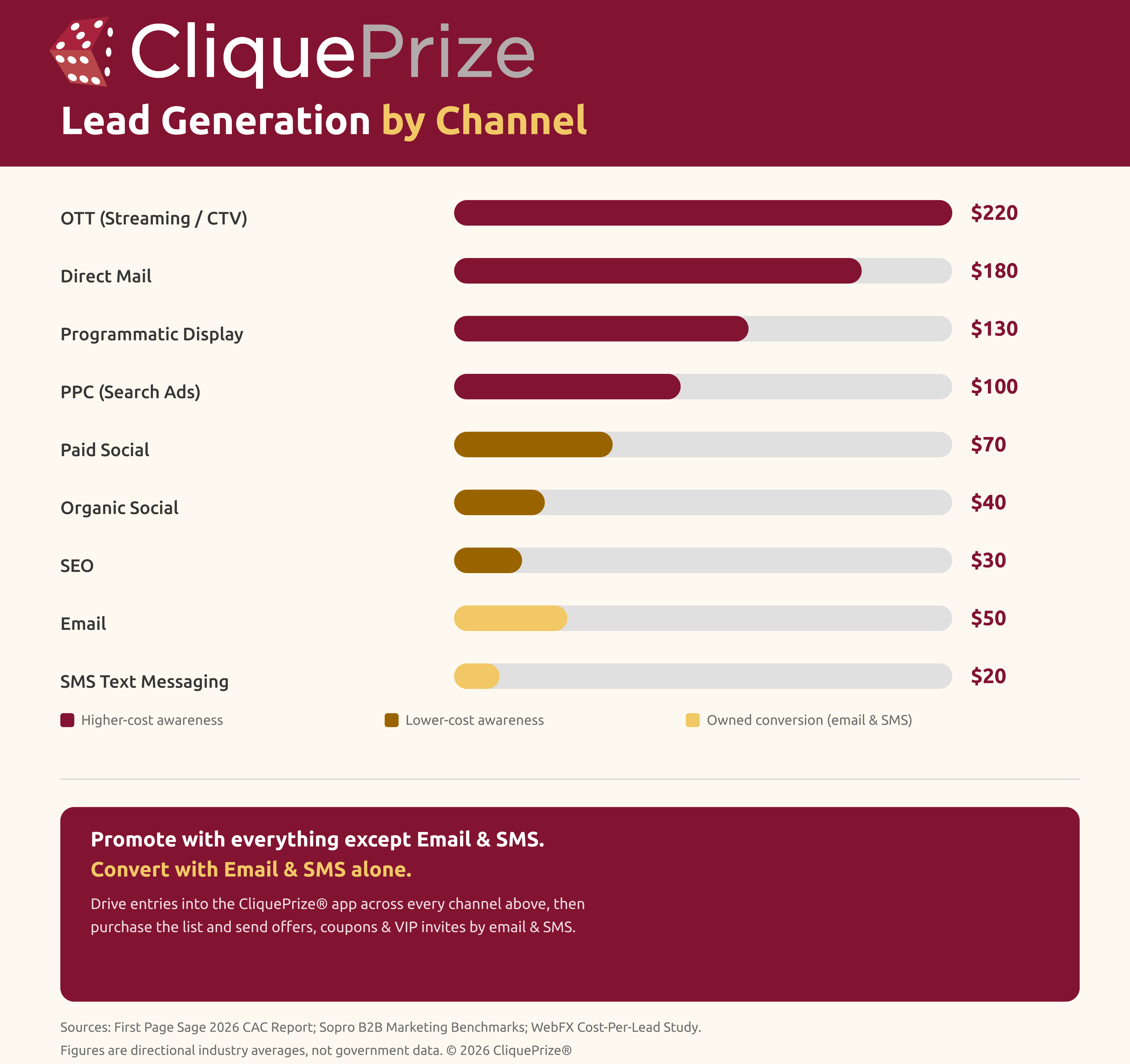
Cost per acquisition for a brick & mortar business varies significantly by industry, and it's worth knowing roughly where your category sits before you set a marketing budget. A restaurant or bar, with a low price point and frequent repeat visits, might see a cost per lead in the $30–$40 range. A gym, salon, or local school (music, swim, karate) often sits in the $55–$65 range. Higher-consideration categories — HVAC, bridal shops, medspas — climb higher, often $95–$180 per lead, because the purchase decision takes longer and the average transaction is bigger. Real estate and interior design, where a single conversion can be worth thousands of dollars, tend to have the highest cost per lead of all local business categories, sometimes exceeding $150–$200.
These are directional, industry-benchmark figures rather than a fixed rule, but the pattern holds across almost every local category: the more expensive and considered the purchase, the more a business can reasonably spend to acquire each lead, and the more valuable a well-built, permanent local list becomes over time.
This is exactly why platforms built specifically for brick & mortar promotion — like CliquePrize® — anchor their pricing around the list, not the individual ad. A campaign can launch for as little as $29, with businesses paying just $1 per verified local lead generated, and never paying for the same lead twice. Because the giveaway prize is typically structured as a tax-deductible business expense, the real cost of building that list often ends up meaningfully lower than even the advertised price — and dramatically lower than what most brick & mortar categories pay per lead through cold paid advertising alone.
 ### Key Brick & Mortar Marketing Terms to Know
A handful of industry terms come up constantly once you start reading about brick & mortar marketing. Knowing them makes it much easier to evaluate a platform, an agency, or a strategy:
- Foot traffic — the number of people who physically walk into your store or location, usually the top-of-funnel metric for any brick & mortar campaign.
- Conversion rate — the percentage of foot traffic (or leads) that actually becomes a paying customer.
- Dwell time — how long a customer spends inside your business; longer dwell time generally correlates with higher spend and stronger brand recall.
- BOPIS — Buy Online, Pick Up In-Store. A hybrid purchase path that still requires the customer to physically visit, and one of the most reliable ways to drive incremental in-store sales.
- ROPO — Research Online, Purchase Offline. Describes the very common behavior of researching a business or product online before buying it in person; it's why local visibility online still drives in-store revenue.
- Geo-fencing — a virtual perimeter drawn around a location (like your store or a competitor's) used to trigger targeted mobile marketing when someone crosses into it.
- Hyperlocal marketing — marketing tailored to a specific neighborhood or radius rather than a city, region, or country — the defining trait of brick & mortar marketing as a discipline.
- Local SEO — optimizing a business's online presence so it appears in location-based searches, like "near me" queries or map-pack results.
- Omnichannel integration — making sure a customer's experience is consistent whether they find you through search, social, email, SMS, or your physical location.
Common Brick & Mortar Marketing Tactics
In practice, brick & mortar marketing tends to draw from a consistent toolkit, even though the specific application varies by industry:
- Giveaways and sweepstakes that use a genuinely desirable, tax-deductible prize to earn an opt-in from a local prospect.
- In-store signage and instant-win promotions that convert people who are already inside the store into list members, not just one-time buyers.
- BOPIS (buy online, pick up in-store) offers that bridge digital browsing and physical foot traffic.
- Local SEO is how a local small business shows up in a search engine to target a nearby customer searching for exactly what it sells.
- Local business partnerships — cross-promoting with complementary, non-competing small businesses in the same area to share audiences at no added acquisition cost.
- Post-promotion email and SMS sequences that turn a list of entrants into a calendar of return visits, rather than a one-time spike in traffic.
Brick & mortar marketing isn't a smaller, local version of digital marketing — it's a different discipline built around a single hard constraint: the customer has to physically show up. Every tactic that respects that constraint, from verified-local targeting to a real post-promotion follow-up plan, tends to work. Every tactic that ignores it, no matter how sophisticated, tends to generate attention that never converts into a customer standing at the counter.
Small businesses that get the most out of their marketing budget are the ones that stop treating a promotion as the finish line and start treating it as the starting point — building a genuinely local list once, and then using the cheapest, most direct channels available to bring that same list back through the door again and again.
Brick & Mortar Marketing FAQ
What is brick & mortar marketing in simple terms?
It's any marketing strategy built to get real, nearby people into a physical business's location — using hyperlocal targeting to earn an opt-in, then direct channels like email and SMS to turn that opt-in into an actual visit.
Is brick & mortar marketing still worth it in a digital-first world?
Yes. Physical stores still generate the large majority of US retail sales, and most shoppers research a business online before ever buying in person — so digital visibility and physical foot traffic reinforce each other rather than compete.
How is brick & mortar marketing different from local SEO?
Local SEO is one tactic inside brick & mortar marketing — it helps a business get found in nearby searches. Brick & mortar marketing is the broader discipline, covering everything from local SEO to giveaways, in-store promotions, and post-visit follow-up.
What's the fastest way to start building a local marketing list?
A giveaway or promotion with a genuinely desirable, tax-deductible prize is typically the fastest, lowest-cost way to earn an opt-in from a verified local prospect, because it gives people an immediate reason to hand over their contact information.
How do I know if my brick & mortar marketing is working?
Track it in two layers: short-term metrics like foot traffic, conversion rate, and cost per lead, and long-term metrics like repeat-visit rate and customer lifetime value. A campaign that generates cheap leads but no repeat visits usually means the post-promotion follow-up is missing, not that the promotion itself failed.
Sources: U.S. Census Bureau retail trade estimates; Capital One Shopping consumer research on in-store vs. online shopping behavior; industry click-and-collect (BOPIS) adoption studies. Figures cited are directional industry benchmarks currently reported by these sources, not real-time or business-specific guarantees.
With CliquePrize®, local businesses can start building that audience for just $29 plus $1 per lead, creating a scalable and affordable path to long-term retail growth.
Take the first step today—start with just $29 and try CliquePrize® for your next promotion.
🚀 Ready to take your marketing to the next level? Download the CliquePrize® app and create a FREE Sponsor Account today!
CliquePrize®*** is the iPhone Giveaways mobile app that helps Small Businesses grow by reaching, nurturing and converting local, high value prospects. If you have any questions or feedback, please let us know!***
Follow Us
Small Business Marketing Tips & Advice
CliquePrize® offers a number of ways to keep updated on Small Business Marketing tips and advice. Follow our RSS Feed, get messages straight to your Twitter inbox, add a Chrome extension or receive each new article via email.
