
What Is Small Business Marketing?
Capturing Opt-In Prospect Data & Converting List Using Direct Channels Such as Email and SMS
Small Business Marketing is the set of local, cost-efficient strategies an independently owned brick and mortar small businesses use to get discovered by nearby customers and turn that attention into repeat visits — ideally built around two phases: capturing opt-in prospect data and converting that list using direct channels such as email and SMS. This is precisely what CliquePrize® was designed to solve. This article is courtesy of CliquePrize®.
By CliquePrize staff
July 23, 2026

What Is Small Business Marketing?
If you own a local business, you've probably heard "marketing" used to mean a hundred different things: a Facebook ad, a mailer, a Google review, a giveaway, a billboard on the highway. All of it technically counts. But for an independent, locally owned business, the term means something more specific than it does for a national brand — and understanding that difference is the fastest way to stop wasting your marketing budget.
Small business marketing is how an independent brick & mortar small businesses gets discovered by the people most likely to become customers, and keeps them coming back, usually on a fraction of the budget a national chain has to work with. It isn't about reaching everyone. It's about reaching the right few thousand people — the ones who live, work, or drive within a realistic radius of your door — and giving them a reason to choose you over the business next door.
That distinction matters because it changes everything about how you should spend your time and money. A national brand can afford to be everywhere, talking to everyone, because their customer could be anyone in the country. A small business can't, and shouldn't try. Your customer is the person fifteen minutes away, and the moment you start marketing like you're competing for the whole country, you start paying national prices for local attention.
What Are the Two Halves of Small Business Marketing?
In short: effective small business marketing splits into two phases — promotion (earning attention and an opt-in from strangers) and conversion (turning that opted-in list into paying customers through owned channels). Most small business owners think of marketing as a single activity: get the word out. In practice, the strongest small business marketing always breaks into two distinct phases, and businesses that only do the first half are leaving most of their return on the table.
Phase one is awareness and entry. This is everything you do to get in front of people nearby who don't yet know you exist, and to turn that attention into something you own — a name, a phone number, an email address. This phase runs on outward-facing channels: paid and organic social media, local SEO, pay-per-click search ads, programmatic display advertising, streaming TV (OTT), and even direct mail. The goal of this phase isn't a sale. It's an opt-in. You're not trying to close a customer today; you're trying to get a verified local prospect to raise their hand.
Phase two is conversion and retention. Once someone has opted in — entered a giveaway, joined your list, signed up in-store — the channels change completely. Now you're working with email and SMS text messaging: direct, owned channels where you're not competing for attention in a crowded feed or paying a platform every time you want to reach someone. This is where coupons, exclusive offers, and VIP event invitations go to work, and it's where most of the actual revenue in small business marketing gets made, because you're talking to people who have already told you they're interested.
The mistake most small businesses make is spending 100% of their marketing effort and budget on phase one and never building a real system for phase two. They run an ad, get some likes, and move on to the next campaign — without ever capturing a list they can market to again for free. Every dollar spent on awareness that doesn't end in a captured contact is a dollar spent once. Every dollar spent building a list is a dollar you can spend on again and again.
Why Is List Building the Real Goal in Small Business Marketing?
In short: a list of verified local contacts is an asset you own and can market to for free, indefinitely — unlike social media followers or a single ad campaign, which you're only ever renting. If there's one idea that separates small businesses that grow steadily from those that spend nervously on marketing every quarter, it's this: your list is the asset. Not the ad campaign, not the social media followers, not even the single sale — the list of verified local people who've opted in to hear from you.
A list you own is fundamentally different from an audience you rent. Every time you post on social media, you're borrowing attention from a platform that can change its algorithm, raise its ad prices, or simply decide to show your content to fewer people tomorrow than it did today. But an email list or an SMS list is yours. Nobody can de-prioritize it, throttle it, or charge you more to reach the same person twice.
This is why giveaways, sweepstakes, contests, and prize-based promotions have become such an effective small business marketing tool: they give people an immediate, low-friction reason to opt in. Nobody signs up for your email newsletter for fun, but plenty of people will enter to win something they actually want. The prize does the work of getting the contact information; what you do with that contact information afterward is where the business growth actually happens.
How Much Does Small Business Marketing Cost?
In short: cost per lead ranges from roughly $20–$50 on owned channels like SMS and email up to $150–$220+ on paid channels like OTT and direct mail, which is why building a list once and converting it repeatedly beats paying full price for every new customer. One of the most common questions small business owners ask is simply: how much should this cost? The honest answer is that it depends heavily on which channel you're using, because cost per lead varies enormously across the marketing landscape.
Broadly speaking, owned channels like email and SMS are the cheapest way to generate a lead once someone is already on your list, often running in the tens of dollars per lead or less. Organic social and local SEO sit in a similar low-cost tier, though they require more time investment upfront. Paid channels — paid social, pay-per-click search ads, programmatic display, direct mail, and streaming TV advertising — climb steadily higher, with some of the most expensive channels costing well over $150–$200 per lead depending on your industry and market.
This is precisely why the two-phase model matters so much for a small business budget. If you're paying premium prices to reach cold, unknown prospects every single time you want a customer, your marketing costs will always be volatile and often unsustainable. But if you invest in building a list once — through a well-run promotion — you can convert that same list repeatedly using the cheapest channels available (email and SMS), without paying acquisition costs a second time.
This is the model platforms like CliquePrize® are built around. A campaign can launch for as little as $29, and businesses pay just $1 per verified, local lead the promotion generates — never twice for the same contact. Because the prize itself is typically a tax-deductible business expense, the effective cost of acquiring each new lead is lower still. Compare that to $100–$200+ per lead through cold paid advertising, and the value of building a list first becomes obvious.
 ## Does Small Business Marketing Vary by Industry?
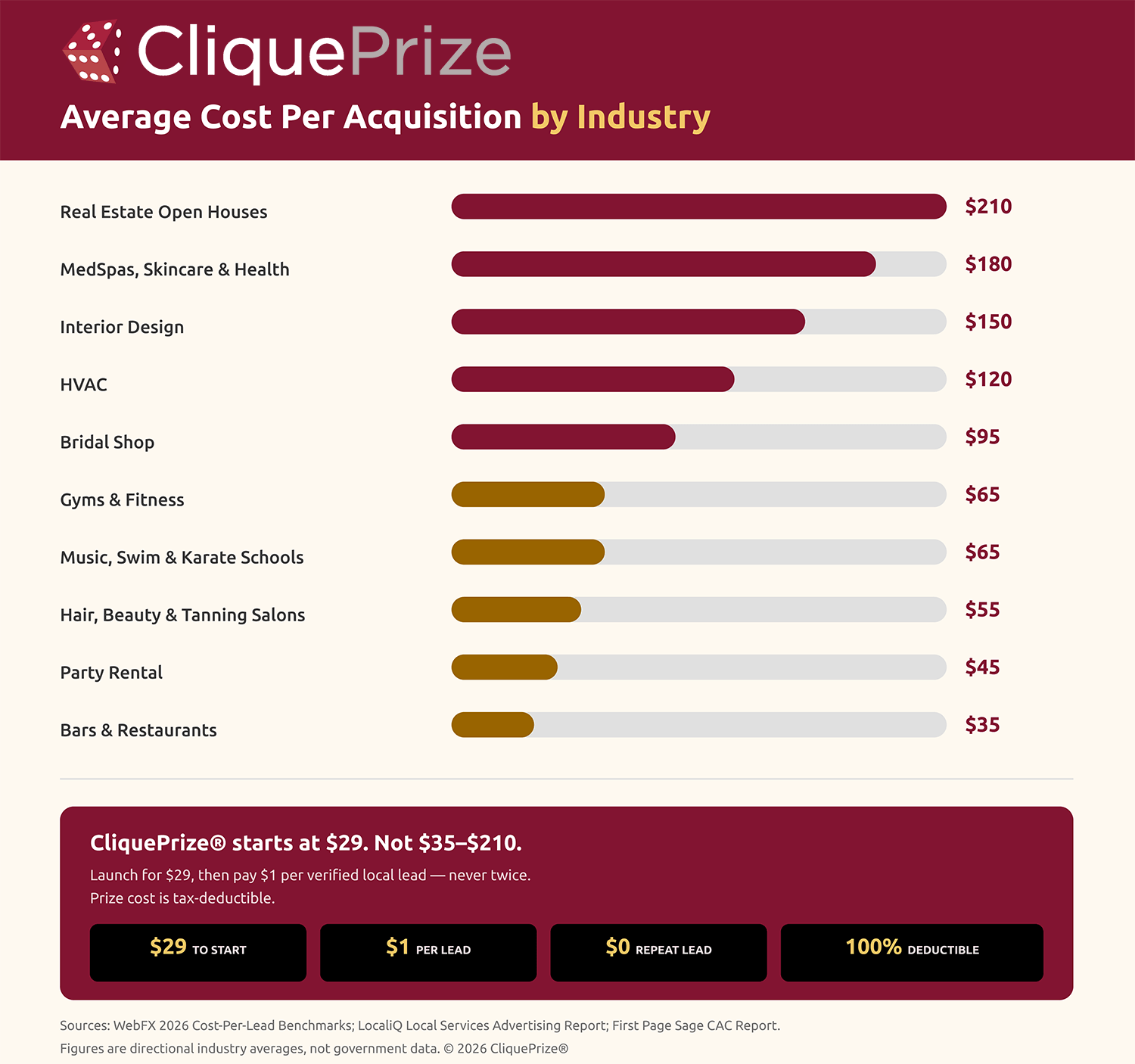
In short: yes — a restaurant, a gym, and a real estate agent each have different sales cycles and price points, so a "good" cost per lead and channel mix for one can be the wrong answer for another. Small business marketing isn't one-size-fits-all, even within the "small business" category. A gym, a medspa, a restaurant, and a real estate agent all have wildly different customer journeys, price points, and purchase frequencies, and that changes what a healthy cost per lead and what an effective channel mix looks like for each. A restaurant might convert leads into visits within days through a simple SMS coupon. A real estate agent might nurture the same lead through email for months before a purchase happens. Neither business is doing it wrong — they're just operating on different timelines with different customer intent.
This is why the smartest small business owners don't just ask "what is marketing" in the abstract — they ask what a healthy customer acquisition cost looks like specifically for their industry, and they build a channel strategy around that number rather than copying whatever worked for a completely different type of business.
How Do You Put Small Business Marketing Into Practice?
If you're a small business owner trying to build (or rebuild) your marketing from scratch, the two-phase model gives you a simple checklist:
Start with a reason for people to opt in. A giveaway, contest, or promotion with a real, tax-deductible prize is one of the fastest, lowest-friction ways to get local people to hand you their contact information.
Promote that promotion broadly. Use every awareness channel available to you — social, SEO, PPC, display, OTT, direct mail — to get as many verified local entries as possible.
Never let the list sit idle. The moment the promotion ends, move into phase two: email and SMS campaigns with real offers, coupons, and VIP invitations that give people a specific reason to walk through your door.
Track cost per lead by channel, not just by campaign, so you know which parts of your budget are earning their keep and which aren't.
Treat your list as the asset you're building, not a byproduct of the campaign. A list you own compounds in value every time you use it; an ad you ran once doesn't.
Small business marketing, at its core, isn't about being clever or being everywhere. It's about being deliberately local, capturing the attention you earn instead of letting it evaporate, and having a real system to turn that attention into repeat, paying customers — over and over, without paying full price for the same customer twice.
Key Takeaways
Small business marketing is local and list-driven, not broad and reach-driven.
It runs in two phases: promote (earn attention and an opt-in) and convert (turn that opt-in into a sale via email and SMS).
A list you own is a reusable asset; an ad you ran once is a sunk cost.
Cost per lead varies by channel — owned channels like SMS and email are cheapest; paid channels like OTT and direct mail are most expensive.
What counts as a "good" cost per lead depends on your industry's price point and sales cycle.
Small Business Marketing FAQ
What is small business marketing in simple terms?
Small business marketing is how a locally owned business gets found by nearby customers and gets them to come back, using low-cost, hyperlocal tactics instead of the broad-reach advertising a national brand would use.
How is small business marketing different from enterprise marketing?
Small business marketing works with smaller budgets, a localized audience, and faster experimentation, while enterprise marketing typically involves bigger budgets, broader national or global reach, and longer approval cycles.
What are the best marketing channels for a small business?
For promotion: paid and organic social, local SEO, PPC, programmatic display, OTT, and direct mail. For conversion, once someone has opted in: email and SMS, which are the lowest-cost, highest-control channels a small business owns outright.
How much should a small business spend on marketing?
There's no universal number — it depends on your industry's typical cost per lead and sales cycle. A useful benchmark is to compare what you're paying per lead on paid channels against what it costs to convert an existing list with email and SMS, and shift budget toward the latter wherever possible.
Why do giveaways work so well for small business marketing?
A giveaway gives someone an immediate, low-friction reason to hand over their contact information, which is usually the hardest part of small business marketing. The prize earns the opt-in; what a business does with that contact afterward is what actually drives revenue.
Take the first step today—start with just $29 and try CliquePrize® for your next promotion.
🚀 Ready to take your marketing to the next level? Download the CliquePrize® app and create a FREE Sponsor Account today!
CliquePrize®*** is the iPhone Giveaways mobile app that helps Small Businesses grow by reaching, nurturing and converting local, high value prospects. If you have any questions or feedback, please let us know!***
Follow Us
Small Business Marketing Tips & Advice
CliquePrize® offers a number of ways to keep updated on Small Business Marketing tips and advice. Follow our RSS Feed, get messages straight to your Twitter inbox, add a Chrome extension or receive each new article via email.
